Is your job on the AI list? What the data actually shows.
Most of what you hear about AI and jobs is prediction. These seven findings come from payroll records, layoff counts and a new law, each with a date and a source.
Two are below. Get all seven, and a card you can save to your phone, by subscribing to Human Terms: one free email every Tuesday on what happened in AI that week and what it means for your job.
Form not loading? Subscribe here
-
The squeeze is on the first rung
AI isn’t showing up as mass firings. It’s showing up as fewer young people getting hired into jobs AI can do.
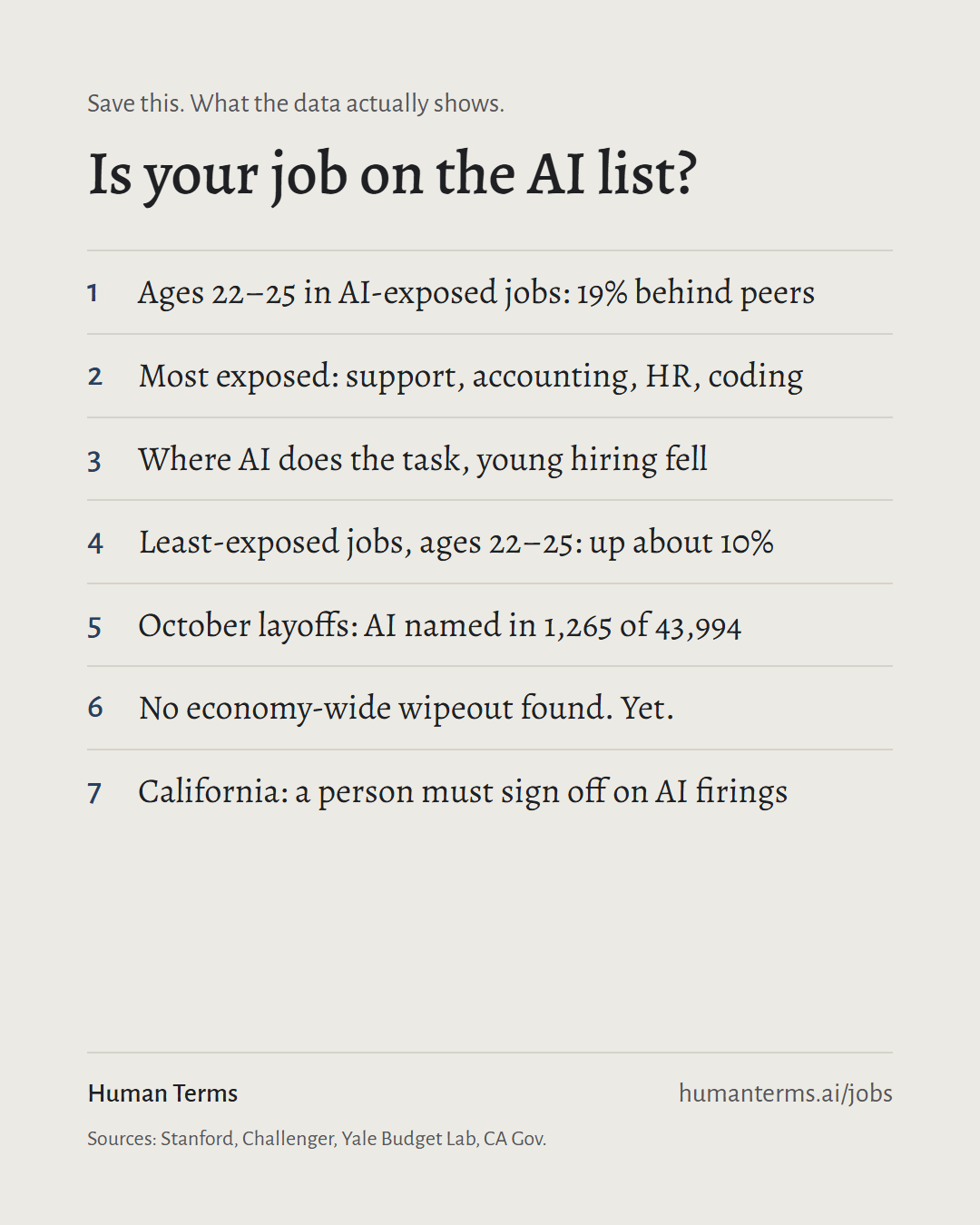
The evidence. Stanford researchers tracked payroll records for millions of US workers through June 2026. Workers aged 22 to 25 in the jobs most exposed to AI are 19% below where they’d be if they had kept pace with peers in less-exposed jobs. Experienced workers in the same jobs show no comparable gap. Updated August 2026. Stanford Digital Economy Lab
-
The most-exposed jobs are desk jobs
The jobs where AI can do the most of the work are office jobs built on writing, numbers and answering questions. If your work happens mostly on a screen, you’re closer to this list.
The evidence. The biggest jobs in the study’s most-exposed group include customer service reps, accountants, HR specialists, software developers, receptionists and marketing analysts. For 22- to 25-year-olds in the most-exposed jobs, employment fell about 11% between November 2022 and June 2026. Stanford paper
-
Check: does AI do the task, or help you do it?
“Exposed” doesn’t mean “replaced.” What matters is whether AI does the work instead of you, or helps you do it faster. Go through your week and sort your tasks into those two piles.
The evidence. In the Stanford payroll data, the job losses for young workers were in jobs where AI mostly does the task. Where AI mostly helps people, employment was flat or rising, especially for experienced workers. In Anthropic’s own data on how people use its Claude AI, 52% of conversations in November 2025 were people working alongside it, against 45% handing a task over. Stanford paper · Anthropic, Jan 15, 2026
-
Hands-on jobs aren’t on the list
AI is good at words and numbers on a screen. It can’t fix a car, lift a patient or wire a building, and the hiring data shows it.
The evidence. In the same payroll data, employment of 22- to 25-year-olds in the least-exposed jobs grew about 10% between November 2022 and June 2026. That group includes janitors, home health aides, construction laborers and car mechanics. Stanford paper
-
When a company blames AI, check the number
“AI” in a layoff announcement is often a label, not a cause. Companies say what sounds good to investors, and the reasons they give change month to month.
The evidence. US employers announced 43,994 job cuts in October 2026. AI was named for 1,265 of them, its lowest month this year. Across the year AI was named in about 20% of cuts, and “market and economic conditions” has overtaken it as the top reason. Challenger, Gray & Christmas, Nov 5 · Issue #9
-
No economy-wide wipeout, yet
Across the whole economy, researchers can’t find AI costing jobs so far. Big forecasts are a different thing: they’re models of what could happen, not counts of what has.
The evidence. Yale’s Budget Lab found “no clear evidence of AI effects on the labor market, but this could change quickly” (May 7, 2026). On the forecast side, McKinsey estimated on September 29 that about 11 million US workers may need to switch occupations by 2035. That’s an estimate, not a count. Yale Budget Lab · Issue #11
-
In California, a person has to sign off before AI fires you
California’s No Robo Bosses Act says an employer can’t rely only on an AI system to discipline or fire someone. If it relies mainly on one, a person has to check the AI’s finding, and you have to be told in writing.
The evidence. Governor Newsom signed SB 947 on September 30, 2026. It takes effect July 1, 2027. It covers employees, not job applicants, and a violation carries a $500 penalty. Office of the Governor · Issue #12
Save it. Download the card (an image for your phone), or bookmark this page.
Every Tuesday at 7am, Human Terms tells you what happened in AI that week and what it means for your job, in plain English. Read past issues.