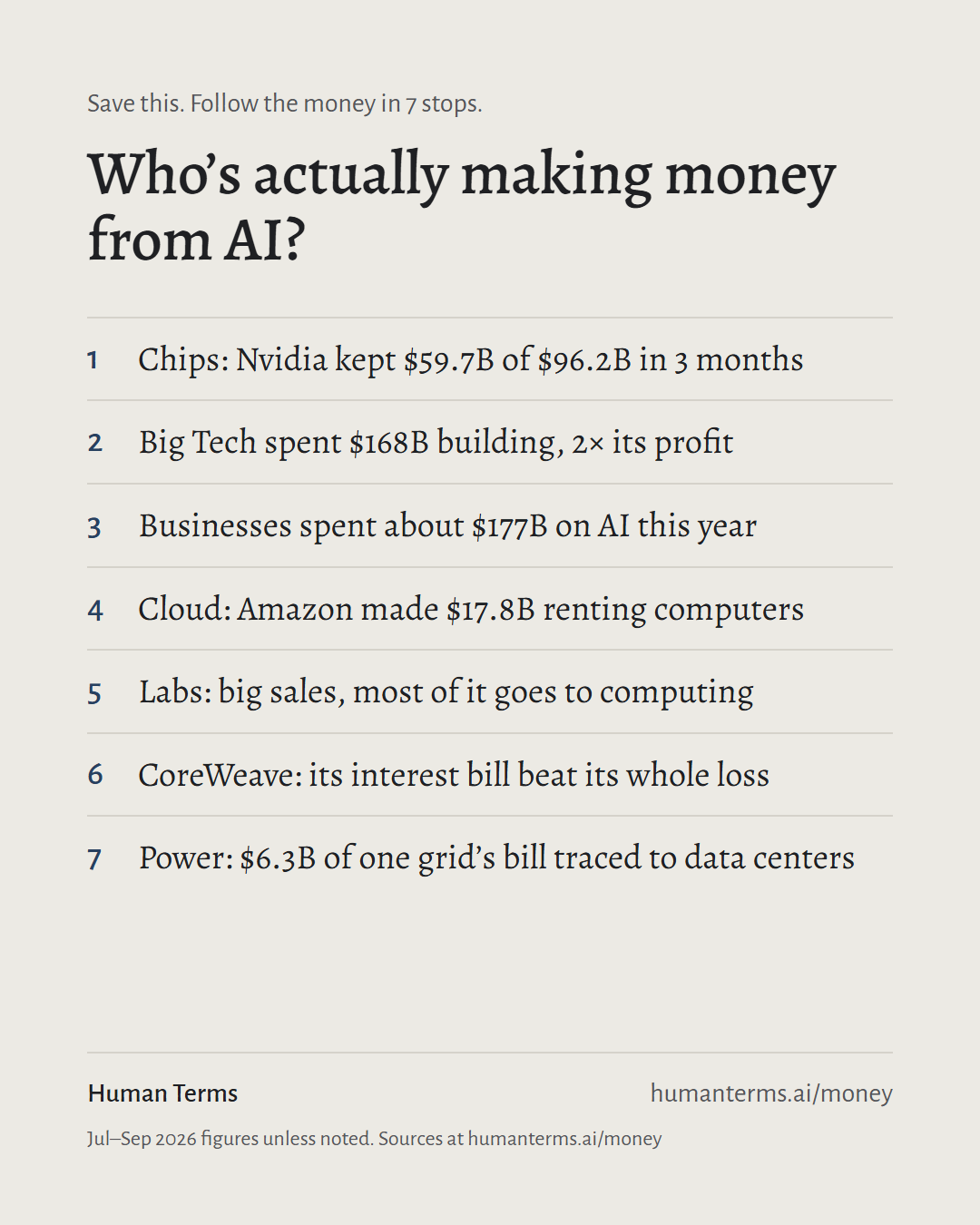
Who’s actually making money from AI? Follow it in 7 stops.
Everyone is spending on AI, but only some of them are making money from it. These seven stops follow the money from the chips to your power bill, using each company’s own reports and dated numbers.
Two are below. Get all seven, and a card you can save to your phone, by subscribing to Human Terms: one free email every Tuesday that explains the week’s AI news, money included, in plain English.
Form not loading? Subscribe here
-
The chip seller keeps 62 cents of every dollar
Nvidia makes the chips nearly every AI company needs, so it gets paid first. In three months it sold $96.2 billion of products and kept $59.7 billion as profit.
The numbers. $89.0 billion of those sales were data-center chips, up 117% in a year. One customer alone was 16% of sales. Three months to July 26, 2026. Nvidia’s filing
-
Big Tech is spending twice its profit on AI buildings
Amazon, Alphabet (Google’s parent) and Microsoft build the data centers those chips go into. Between July and September they spent $168 billion on buildings and equipment. That’s about $1.8 billion a day, and about twice what the three made in profit.
The numbers. Amazon $77.3 billion, Alphabet $51.4 billion, Microsoft $39.4 billion, up from $78.4 billion in total a year earlier. Their combined profit was $83.8 billion. July–September 2026. Amazon · Alphabet · Microsoft · Issue #14
-
Where the money starts: businesses paying for AI
Most of the money flowing into AI starts with companies paying for it at work, not with people paying for chat apps. One survey says business spending on AI grew more than fivefold in a year.
The numbers. About $177 billion in 2026, up from $33 billion in 2025, and 69% of it went to Anthropic, OpenAI and Google. It’s an estimate from a survey of nearly 400 US decision-makers by Menlo Ventures, which has invested in Anthropic. Menlo Ventures, Nov 3
-
The cloud landlords collect rent
Most AI runs on computers rented from Amazon, Google and Microsoft. Renting out computing power is where they earn their AI spending back.
The numbers. Amazon’s cloud: $46.0 billion in sales, $17.8 billion operating profit. Google Cloud: $30.7 billion in sales, about double a year earlier, and $11.1 billion operating profit, up from $3.6 billion. Microsoft’s Azure: sales up 48%. July–September 2026. Amazon · Alphabet · Microsoft
-
The AI labs: huge sales, little or no profit yet
The companies that build the chatbots sell a lot, then pass much of it on to the chip and cloud companies above. Anthropic is close to breaking even. OpenAI is reported to be losing billions.
The numbers. Anthropic made $33.2 billion in sales in the first nine months of 2026, up from $2.5 billion, and spent 57 cents of every dollar on computing. It lost $1.3 billion on operations. Anthropic’s filing. OpenAI doesn’t publish accounts. It reportedly told investors its sales were running at about $50 billion a year in September. Bloomberg, citing the FT
-
The computer renters run on borrowed money
Smaller AI clouds like CoreWeave borrow to buy Nvidia chips, then rent them out. Sales are doubling, but the loans cost so much that the company still loses money.
The numbers. Sales $2.58 billion, up 112%. Loss $626 million. Interest on its debt: $640 million, more than the whole loss. April–June 2026. CoreWeave
-
Who pays for the power? Sometimes you
Data centers need huge amounts of electricity, and the cost of new power supply is often shared by everyone on the grid. Some states have started billing data centers separately.
The numbers. The grid serving 13 states and DC, from Illinois to New Jersey, paid $16.4 billion in its July 2026 auction for future power. Its independent watchdog reportedly traced about $6.3 billion of that to data centers. New Jersey put data centers in their own billing class on July 7. Utility Dive · Industrial Info · NJ Governor · Issue #1
Save it. Download the card (an image for your phone), or bookmark this page.
Every Tuesday at 7am, Human Terms explains the week’s AI news, money included, in plain English. Read past issues.